

What Is an AI Model? Definition, Types, Examples, and How They Work

Updated:
May 20, 2026
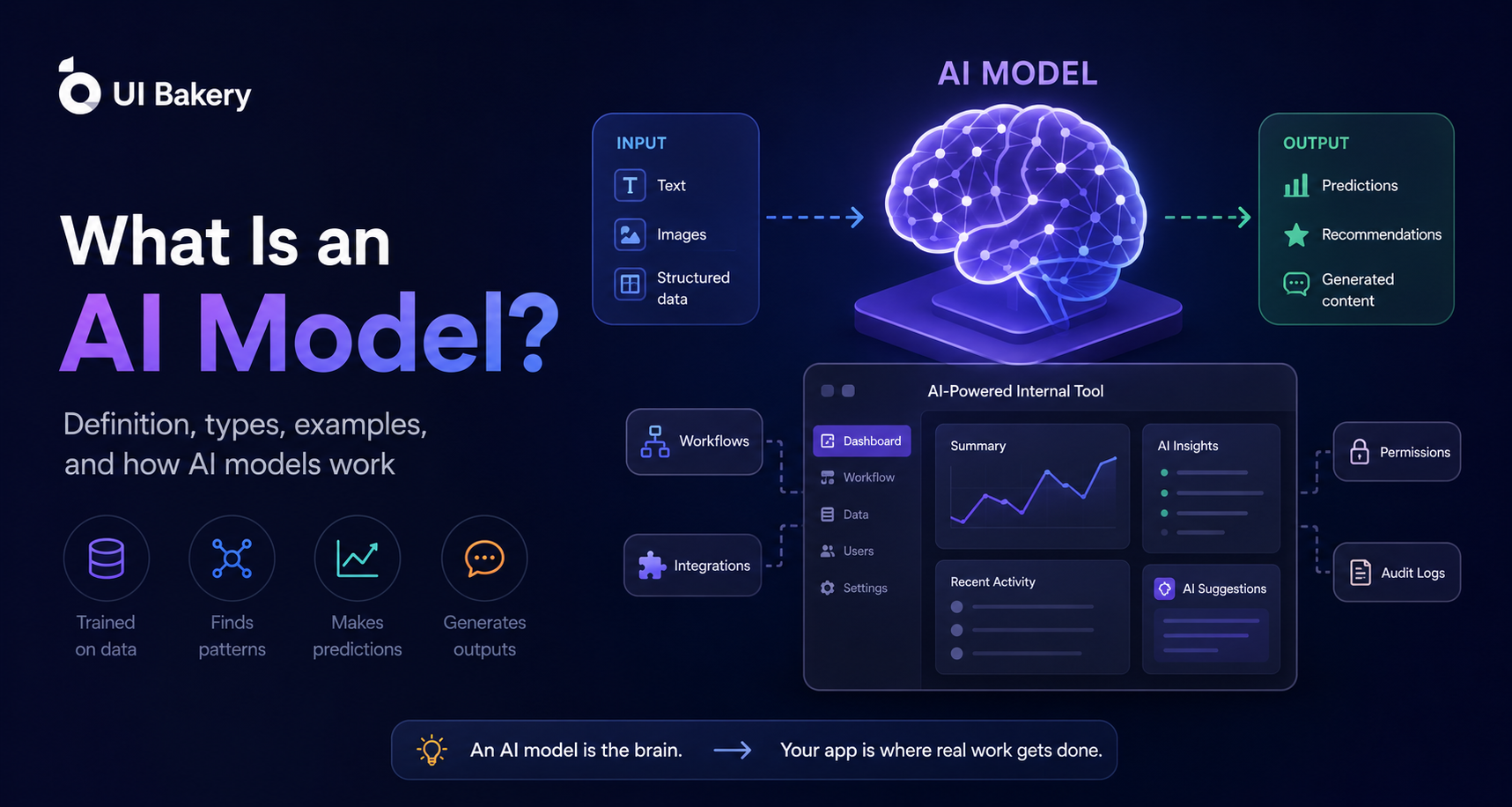
An AI model is a software system trained on data to recognize patterns and produce outputs such as predictions, classifications, recommendations, or generated content. It is the component inside an AI system that transforms input into useful results.
That sounds simple. But most people confuse AI models with AI apps like ChatGPT, AI agents, or complete business tools. In reality, a model is usually only one layer. The software products people use every day include interfaces, permissions, workflows, databases, and integrations around the model itself.
Understanding this difference matters because businesses rarely buy "AI models." They build systems around them.
What Is an AI Model?
Think of an AI model as a prediction engine.
Traditional software follows predefined rules:
if (invoice > 1000) {
   approve = false
}
AI models work differently.
Instead of following hard-coded instructions, they learn patterns from examples.
Imagine you want software to recognize spam emails.
Writing rules manually becomes difficult:
- wording changes
- spam tactics evolve
- attackers adapt behavior
Instead, you provide thousands or millions of examples:
The model studies examples and learns patterns automatically.
After training, it can classify future emails without requiring explicit rules.
That ability to generalize from examples is what makes AI models useful.
AI Model vs Algorithm vs AI App vs AI Agent
These terms are often confused, even inside technical teams.
Think of it this way:
- A model is the brain.
- An AI app is the product users interact with.
- An AI agent combines models with actions.
- An algorithm is one building block underneath everything.
For example, ChatGPT itself is not simply a model. It is a complete application built around a model.
How AI Models Actually Work
Many explainers stop at:
Models learn from data.
But what happens behind the scenes?
AI systems usually move through four stages.
Step 1: Collect data
Models require examples.
Examples:
- support conversations
- invoices
- customer behavior
- emails
- images
- purchase history
- medical records
Data quality matters enormously.
A mediocre model with excellent data often outperforms an advanced model with poor data.
This is one reason businesses increasingly focus on proprietary datasets.
Step 2: Training
During training, the model repeatedly processes examples.
Internally, it adjusts millions or billions of parameters.
Its goal:
Reduce mistakes.
Depending on model complexity, training can take:
- minutes
- days
- weeks
- months
Step 3: Evaluation
Teams test whether the model actually works.
Typical metrics include:
- accuracy
- precision
- recall
- latency
- false positives
- hallucination rates
Different industries optimize for different metrics.
Healthcare systems and movie recommendations do not measure success in the same way.
Step 4: Inference
Inference simply means:
Using the trained model.
When ChatGPT answers a question or a recommendation engine suggests products, inference is happening.
Most applications spend far more time performing inference than training.
Why Companies Usually Do Not Train Their Own Models
This is one of the biggest misconceptions around AI.
People hear "AI model" and imagine companies building GPT-sized systems.
Most companies do not.
Instead they:
- use GPT APIs
- use Claude APIs
- fine-tune existing models
- connect models to internal company data
Why?
Because training models requires:
- large datasets
- GPU infrastructure
- machine learning expertise
- ongoing maintenance
- substantial cost
For many organizations, buying intelligence is cheaper than building intelligence.
Competitive advantage increasingly comes from workflows and proprietary company data rather than model architecture.
Main Types of AI Models
Different AI models solve different problems.
AI Model vs LLM: Why People Get Confused
Many people assume:
AI model = ChatGPT.
That is incorrect.
ChatGPT uses a large language model underneath.
But AI models also include:
- recommendation systems
- fraud detection
- prediction engines
- search ranking systems
- computer vision systems
Every LLM is an AI model.
Not every AI model is an LLM.
A logistics company may use multiple model types simultaneously:
- forecasting models
- OCR models
- language models
- recommendation engines
—all inside one workflow.
Real Examples of AI Models in Business
Companies rarely deploy models directly.
They deploy workflows.
Support teams
Models classify tickets.
Then workflows:
- assign priorities
- route requests
- notify teams
- suggest replies
Finance operations
Models extract invoice information.
But teams still need dashboards, review flows, and audit logs.
Many organizations build operational internal tool examples around these outputs.
Healthcare
Models identify patterns and classify patient information.
Humans remain involved because errors carry consequences.
Sales teams
Models score leads and trigger CRM updates.
The workflow often matters more than the model itself.
The Mistake Teams Make After Choosing a Model
Teams often think:
We selected GPT. Problem solved.
Reality starts afterward.
Now organizations suddenly need:
- permissions
- approvals
- interfaces
- dashboards
- audit logs
- monitoring
- integrations
- human review
This operational layer often becomes larger than expected.
Many companies eventually build internal tools around AI systems instead of exposing raw outputs directly.
An AI app generator helps teams create dashboards and workflow interfaces around AI systems.
Teams can also use an OpenAI integration or directly connect OpenAI as a data source to integrate model outputs into operations.
Limitations and Risks of AI Models
AI models remain imperfect.
Common issues include:
- hallucinations
- biased datasets
- outdated information
- inconsistent outputs
- privacy concerns
- weak explainability
This is why businesses often use humans in the loop rather than fully autonomous systems.
Especially in:
- healthcare
- finance
- legal
- compliance-heavy industries
Final Thoughts
AI models are increasingly becoming infrastructure rather than products.
The model itself rarely creates value on its own.
Value appears when organizations combine models with workflows, interfaces, permissions, human review, and operational systems.
The companies winning with AI today are often not the ones training the largest models.
They are the ones building better systems around them.
Next step
Planning a HIPAA-sensitive internal app?
Use the checklist above to map data flow, roles, audit events, vendors, and deployment decisions before the first production workflow ships.
Healthcare operations example
Action Behavior Centers scaled internal operations across clinics with UI Bakery
For a real operational example, review UI Bakery customer stories and healthcare operations patterns.
5,000+users supported in the customer story
400+clinics mentioned in the case study
Is ChatGPT an AI model?
Not exactly. ChatGPT is an application built around AI models.
Can companies train their own AI models?
Yes, but many use existing APIs because training can be expensive and operationally complex.
Do AI models continue learning automatically?
Usually not. Most require retraining or fine-tuning.
How many AI models are there?
Thousands exist across industries and use cases.
What is the difference between an AI model and an AI app?
An AI model generates outputs. An AI app includes workflows, interfaces, permissions, and user-facing functionality built around those outputs.





"The UI Bakery platform offers a cost-effective approach to creating applications. With UI Bakery, you can achieve your app development goals without breaking the bank."

"Before switching to UI Bakery we developed a number of apps within the Retool system. The Retool system was good but ultimately did not have the flexibility and feature sets that we required."
Check the Story