

7 Best Lovable Alternatives in 2026: Compared by Use Case

Updated:
May 15, 2026
Lovable is one of the most visible AI app builders right now, especially for teams that want to turn a prompt into a working UI fast. But once you move beyond the first prototype, the real question becomes less about prompt-to-interface speed and more about what happens next.
Do you need a real backend? Do you need deployment control? Do you need to connect to production data, collaborate across a team, or keep building after the first generated version?
That is where many teams start looking for a Lovable alternative.
In this guide, we compare the best Lovable alternatives in 2026 for different use cases: internal tools, full-stack app generation, AI-assisted coding, browser-based development, and deployable React apps. Rather than ranking tools by hype, we focus on which one is best for the kind of product you actually need to ship.
If you want the short version, here is where to start:
- Choose UI Bakery if you need internal tools, admin panels, dashboards, or CRUD apps connected to real business data.
- Choose Cursor if you want AI pair programming inside a code editor and full control over a real codebase.
- Choose Bolt.new if you want prompt-to-app generation with a full-stack developer workflow.
- Choose Replit if you want browser-based coding, deployment, and collaboration in one place.
- Choose Meku if you want to generate and launch React apps with more ownership over the output.
- Keep Lovable if your main goal is fast UI prototyping and early concept exploration.
When Lovable is a good fit:
Lovable is still a good fit if you:
- want to go from prompt to UI quickly
- are validating a product idea or workflow
- care more about speed than deep backend architecture
- want a lightweight starting point for design-to-code experimentation
When to choose an alternative:
You should look at Lovable alternatives if you:
- need backend logic, authentication, database workflows, or real integrations
- want stronger developer control over the generated code
- need role-based access, deployment flexibility, or self-hosting options
- are building internal tools, admin apps, or operational software
- need better collaboration for engineering or enterprise teams
UI Bakery – best Lovable alternative for internal tools and operational apps

UI Bakery is the strongest Lovable alternative if your team is not trying to generate a landing page or a demo UI, but an actual internal app that needs to work with real business data.
Where Lovable is strongest at quickly generating the first interface from a prompt, UI Bakery goes further into the operational part of app building: admin panels, internal tools, CRUD apps, approval flows, and dashboards connected to databases or APIs.
The difference matters. Many teams do not stop at “generate a screen.” They need filters, tables, forms, permissions, logic, and deployment options. That is where UI Bakery fits better.
You can generate an app from a prompt, connect it to real data, refine the interface visually, add business logic, and keep iterating inside the same environment. That makes it a better fit for product, operations, and engineering teams that need apps people will actually use internally.
Best for: teams building internal tools, admin panels, dashboards, and workflow apps on top of real data sources.
Why choose it over Lovable:
- built for operational apps, not just initial UI generation
- connects to databases, REST APIs, and GraphQL APIs
- lets you visually refine generated output instead of starting over
- supports role-based access, deployment options, and enterprise workflows
- works well when the app has to survive beyond the prototype phase
Cursor – best Lovable alternative for AI pair programming
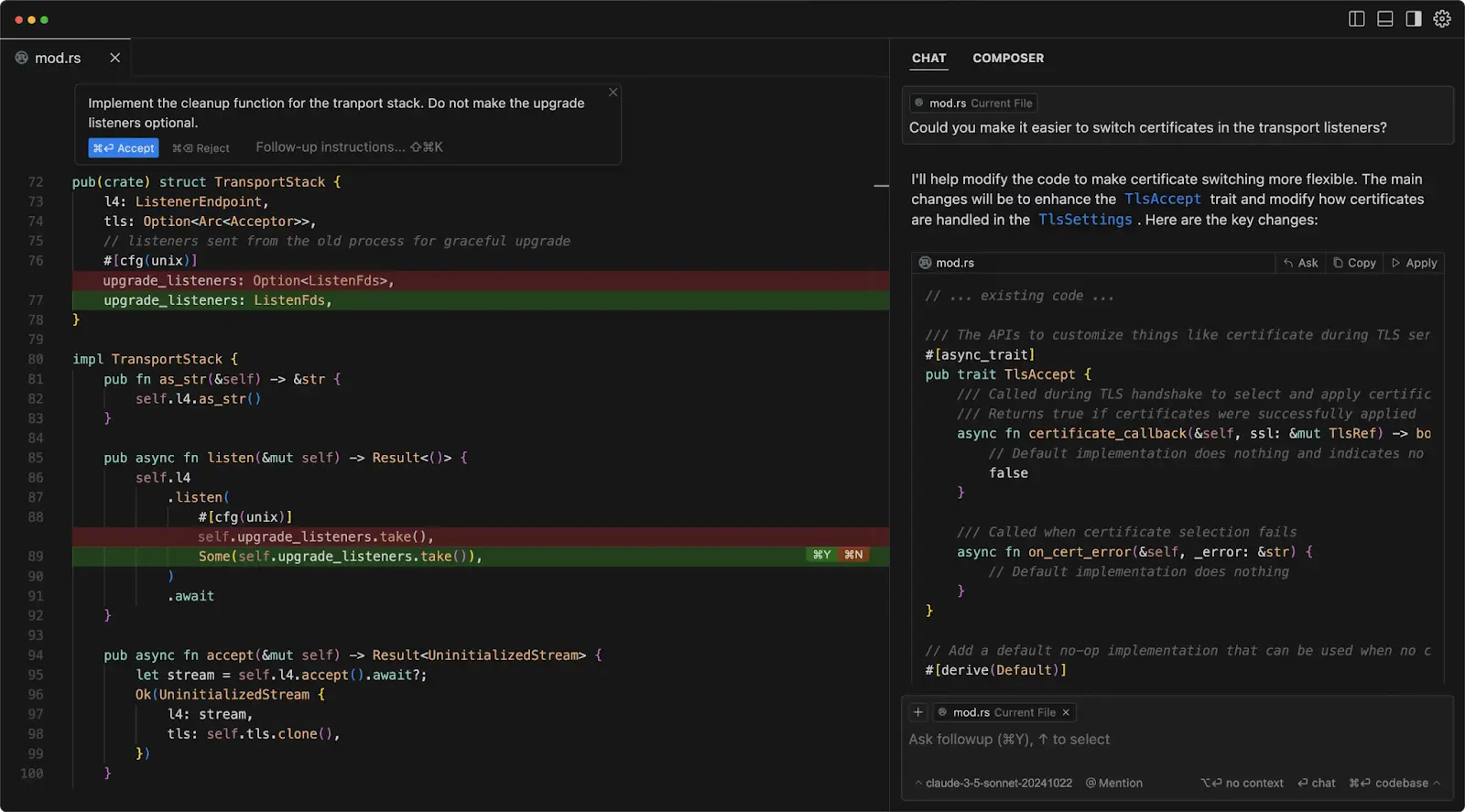
Cursor is a better Lovable alternative for developers who want AI inside the coding workflow rather than outside it.
Lovable is useful when you want a fast generated interface. Cursor is more useful when you already have a codebase, need to understand it, refactor it, extend it, or build directly in an IDE with AI as an active collaborator.
That makes Cursor a very different kind of alternative. It is not a visual app builder. It is an AI-powered code editor for people who want full control over the implementation.
If your team is deciding between a prompt-first builder and a developer-first workflow, Cursor wins when maintainability, debugging, and iteration inside a real codebase matter more than visual generation speed.
Best for: engineering teams, technical founders, and developers working on real codebases.
Why choose it over Lovable:
- stronger for editing, refactoring, and understanding existing code
- better fit for long-lived production projects
- supports a real developer workflow instead of a mostly generation-first flow
- more useful when the bottleneck is implementation, not initial UI scaffolding
Bolt.new – best Lovable alternative for full-stack MVP generation

Bolt.new is one of the strongest Lovable alternatives if your main complaint with Lovable is that it stops too early.
Lovable is often used to generate the first UI. Bolt.new is more appealing when you want a fuller app-building workflow with both frontend and backend layers in play. It is better aligned with teams that want a prompt-to-app experience but still need a developer-oriented stack behind the output.
This makes Bolt.new especially attractive for startup teams, technical founders, and product builders trying to move from idea to MVP without stitching together too many tools manually.
Best for: startups and product teams building MVPs that need more than a generated interface.
Why choose it over Lovable:
- stronger full-stack orientation
- better fit for prompt-to-product workflows
- more useful when backend logic matters from day one
- better option when the goal is a deployable MVP instead of a UI-first prototype
Replit – best Lovable alternative for browser-based coding and deployment

Replit is the better Lovable alternative when your team wants a cloud development environment instead of a visual-first AI builder.
Rather than focusing mainly on generating UI from prompts, Replit gives you a browser-based development workflow where you can build, edit, run, and deploy apps in one place. That makes it much stronger for teams that need coding, collaboration, and live deployment without forcing everyone into a desktop IDE setup.
It is especially useful for fast-moving teams, education, prototypes that need real code behind them, and products that benefit from shared browser-based collaboration.
Best for: teams that want in-browser development, collaboration, and deployment in one workflow.
Why choose it over Lovable:
- stronger coding and deployment environment
- better for collaborative cloud development
- more flexible once the project moves beyond early visual generation
- better fit when you want a full browser-based build workflow
Meku – best Lovable alternative for shipping React apps with ownership over the output
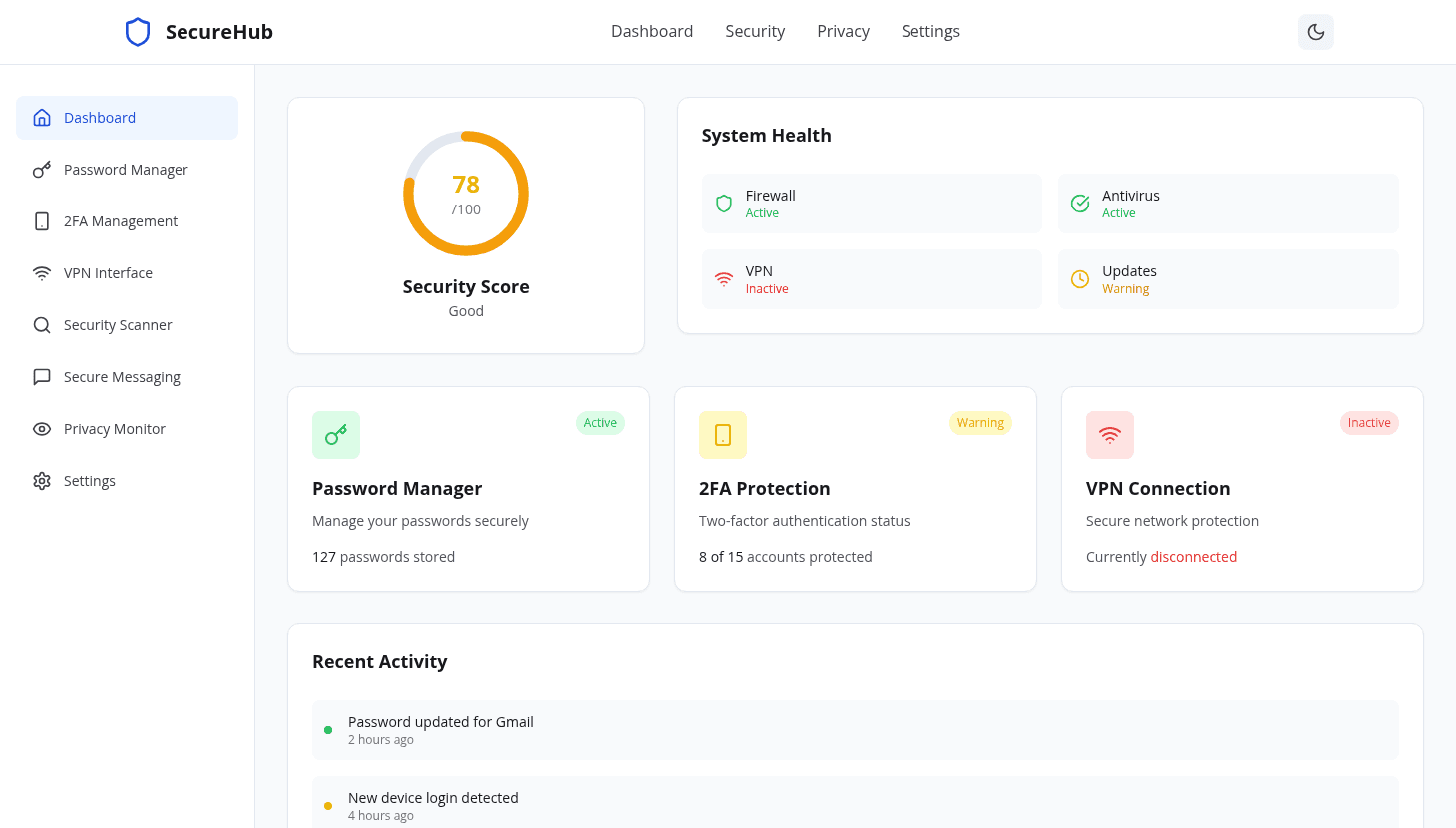
Meku is a compelling Lovable alternative for founders and developers who like the speed of AI app generation but want cleaner ownership over the resulting app.
Instead of stopping at a concept or interface layer, Meku is more focused on turning prompts into deployable React applications that you can continue to customize and launch. That makes it a better fit for teams that want to move from generated output into actual product iteration with less friction.
If your biggest concern with Lovable is whether the generated result can become a real app you continue to own and ship, Meku is worth considering.
Best for: founders and developers who want deployable React apps and more control after generation.
Why choose it over Lovable:
- stronger for launch-oriented app generation
- better fit for teams that want editable React output
- useful when code ownership matters more than pure visual speed
- closer to a “generate and keep building” workflow
Which Lovable alternative should you choose?
Choose UI Bakery if your app is an internal tool, admin panel, dashboard, or CRUD workflow connected to real business data.
Choose Cursor if you want AI inside a serious coding workflow and need to build or maintain real codebases.
Choose Bolt.new if you want a stronger full-stack path from prompt to MVP.
Choose Replit if you want browser-based development, deployment, and collaboration in one place.
Choose Meku if you want to generate React apps that you can own, customize, and ship.
Keep Lovable if your main goal is still fast visual prototyping and early concept validation.
Final thoughts
While Lovable is a great starting point for visual design-to-code workflows, it lacks the backend depth, customizability, and collaboration features required by enterprise-grade projects.
If you’re looking for Lovable AI alternatives that can support real production apps, deeper code control, and robust integrations, the tools listed above offer powerful options. Whether you’re a solo developer, a fast-scaling startup, or an enterprise IT team, there’s a Lovable dev alternative tailored to your needs.
And the best part? Some of these tools even offer free alternatives to Lovable AI, making them accessible for early-stage teams that want to try before they scale.
What is the best Lovable alternative for internal tools?
UI Bakery is the strongest Lovable alternative for internal tools, admin panels, dashboards, and CRUD apps. It is built to work with real databases and APIs, and it supports the workflows most teams need after the first generated screen.
What is the best Lovable alternative for developers?
Cursor is usually the best Lovable alternative for developers who want AI inside a real coding workflow. If you want a prompt-to-app full-stack workflow instead, Bolt.new is another strong option.
What is the best Lovable alternative for full-stack apps?
Bolt.new is one of the strongest Lovable alternatives for full-stack app generation because it is more oriented toward complete app scaffolding rather than frontend-first generation alone.
Can UI Bakery replace Lovable?
For teams building internal tools and operational apps, yes. UI Bakery is a stronger fit when you need real data connections, business logic, visual editing after generation, and deployment-ready internal software.
Is Lovable better than Cursor?
They solve different problems. Lovable is better for fast prompt-to-UI generation. Cursor is better for coding, refactoring, and building inside a real codebase with AI assistance.
Which Lovable alternative is best for startups?
Bolt.new and Meku are both strong choices for startups. Bolt.new is a better fit for teams wanting a fuller prompt-to-app workflow, while Meku is attractive if you want React output you can continue to own and launch.




"The UI Bakery platform offers a cost-effective approach to creating applications. With UI Bakery, you can achieve your app development goals without breaking the bank."

"Before switching to UI Bakery we developed a number of apps within the Retool system. The Retool system was good but ultimately did not have the flexibility and feature sets that we required."
Check the Story