

How to Build Internal Applications on Snowflake Data
.png)
Updated:
March 10, 2026
Modern companies rely on data generated across order systems, warehouse platforms, carrier APIs, and financial infrastructure. Understanding how the business operates requires consolidating this information into a system where it can be queried reliably.
The Snowflake data platform is widely used for this purpose. It provides a scalable cloud data warehouse where organizations store and process business datasets using SQL. Centralizing data enables reporting and analytics, but analytics alone does not solve operational workflows.
Many teams need tools that allow them to interact with records, investigate issues, and monitor live activity across business processes. Operational roles such as warehouse managers, logistics coordinators, and support teams rarely interact with data warehouses directly. Instead, they need interfaces designed for investigation and workflow management rather than query execution.
UI Bakery provides an application layer on top of Snowflake that enables this approach. Internal applications can query warehouse datasets and present them through dashboards, tables, and operational interfaces. This allows teams to work with Snowflake data without exporting datasets or building custom software from scratch.
Turning Snowflake Data Into Applications
To illustrate how this architecture works in practice, consider a logistics company that manages order fulfillment across several warehouses.
Operational data flows into Snowflake from multiple systems, including order management platforms, warehouse software, shipping carriers, and financial systems. Data engineers consolidate and model these records in warehouse tables such as orders, shipments, warehouses, carriers, and delivery events.
While this data supports analytics, the operations team still needs a practical interface to monitor fulfillment activity and investigate issues as they occur. An internal application built on top of Snowflake can provide that operational view.
Using UI Bakery, the company can build a logistics dashboard that visualizes Snowflake datasets in real time.
Operations Dashboard
The operations dashboard provides a real-time overview of fulfillment activity across the logistics network. Managers can monitor key metrics such as orders processed today, shipments in transit, delayed deliveries, and warehouse load. Additional indicators highlight revenue trends, SLA compliance, freight costs, and pending dispatches. These metrics provide a quick assessment of fulfillment performance and highlight potential bottlenecks.
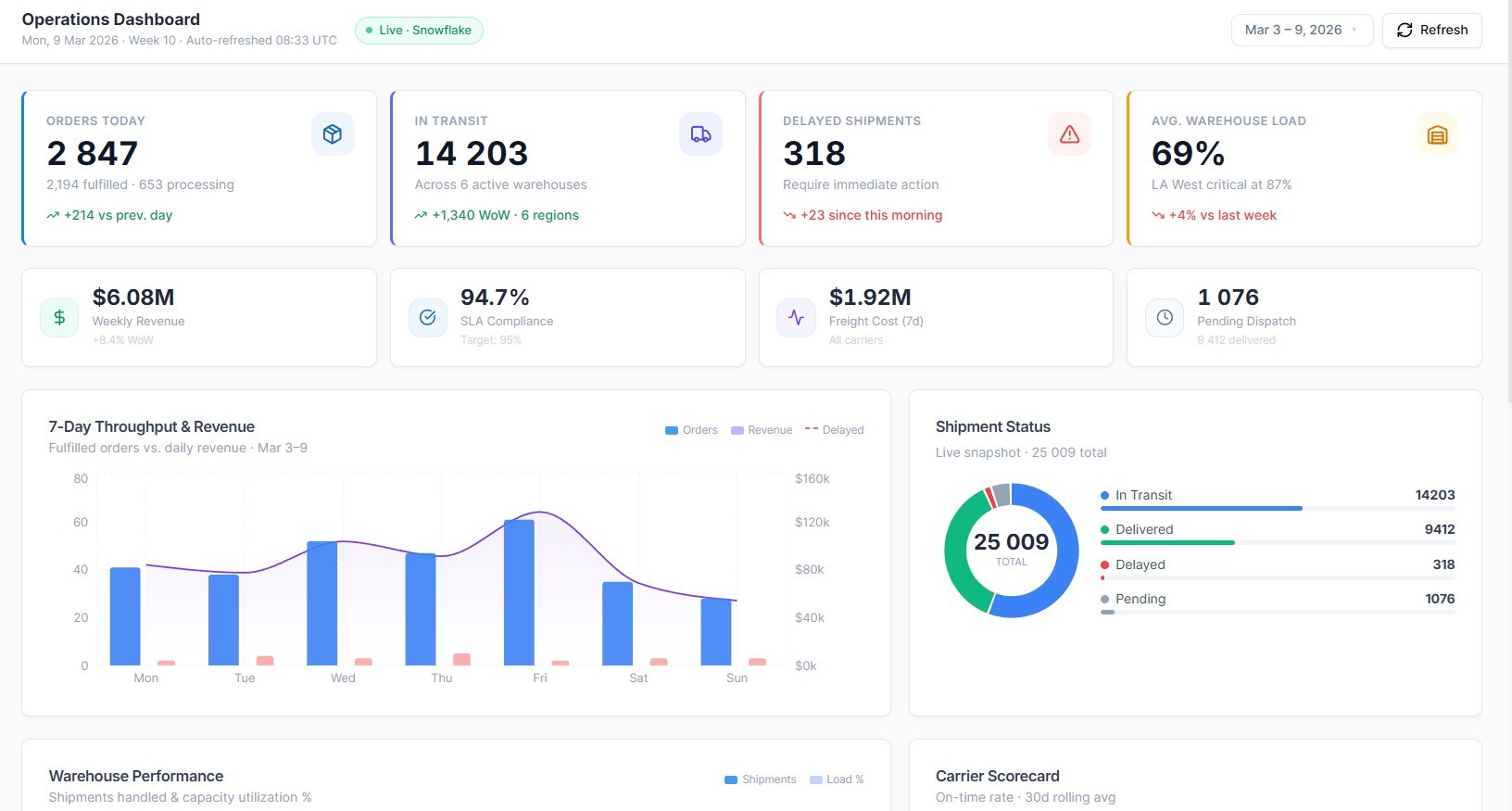
Because the dashboard retrieves data directly from Snowflake, the information reflects the latest activity without requiring manual reports or exports.
Shipment Tracking
The application also includes a shipment tracking interface that allows operations teams to inspect individual records. Shipments are displayed in a structured table containing fields such as shipment ID, order ID, warehouse, carrier, destination, shipment status, estimated delivery date, and delay indicators. Filters allow the team to quickly narrow results by warehouse, carrier, or delivery status.
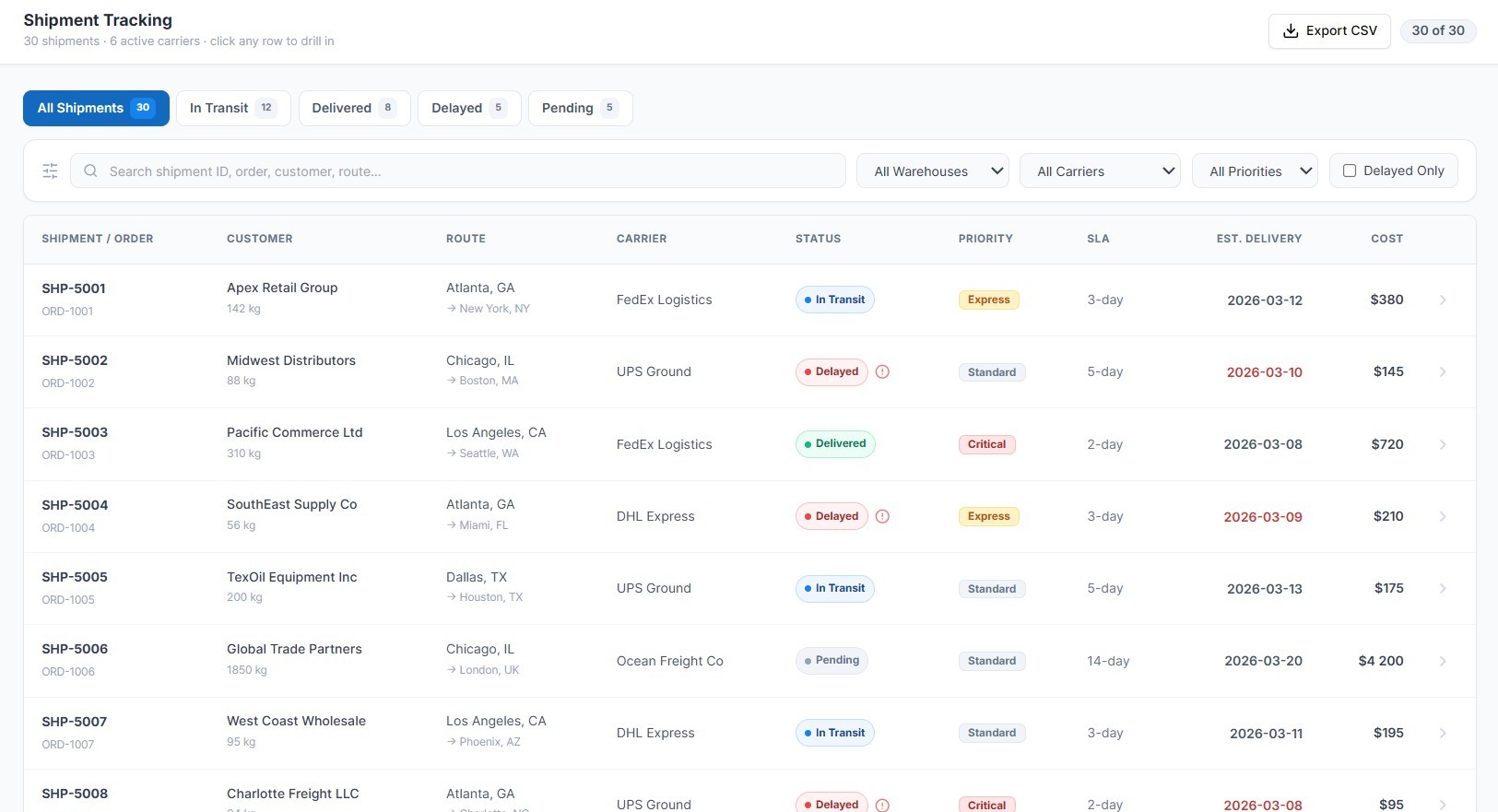
When a delayed shipment appears, the user can open the record to review its delivery timeline. Events stored in Snowflake tables show the sequence of updates during transit, including warehouse departure, carrier checkpoints, and distribution hub updates. Because the interface reads directly from Snowflake, the data remains current without requiring synchronization between reporting tools or spreadsheets.
Architecture: Snowflake as the Data Layer, UI Bakery as the Application Layer
This architecture separates the data platform from the application interface. Snowflake manages centralized data storage, transformations, and analytical queries, while UI Bakery provides the interfaces operational teams use to explore and investigate that data.
Operational dashboards, tables, record inspection, and workflow actions can be built on top of Snowflake datasets without duplicating data or exporting it to external tools. The result is a clear architecture where Snowflake remains the source of truth and UI Bakery provides the operational layer that makes warehouse data usable across the organization.
Final Thoughts
Snowflake has become a core component of modern data infrastructure, providing organizations with a reliable foundation for storing and querying business data. However, a data warehouse alone does not provide the interfaces teams need to work with that data in daily operations. Building internal applications on top of Snowflake extends the warehouse into an operational layer. Teams can monitor processes, investigate issues, and interact with live records without leaving the data platform.
Platforms such as UI Bakery make it possible to build these interfaces quickly while Snowflake remains the source of truth. For companies that already rely on Snowflake, this architecture turns a data warehouse into a system that supports both analytics and operational workflows.
Next step
Planning a HIPAA-sensitive internal app?
Use the checklist above to map data flow, roles, audit events, vendors, and deployment decisions before the first production workflow ships.
Healthcare operations example
Action Behavior Centers scaled internal operations across clinics with UI Bakery
For a real operational example, review UI Bakery customer stories and healthcare operations patterns.
5,000+users supported in the customer story
400+clinics mentioned in the case study





"The UI Bakery platform offers a cost-effective approach to creating applications. With UI Bakery, you can achieve your app development goals without breaking the bank."

"Before switching to UI Bakery we developed a number of apps within the Retool system. The Retool system was good but ultimately did not have the flexibility and feature sets that we required."
Check the Story