
.jpg)
AI Model Governance: Framework, Best Practices, and Implementation Guide

Updated:
May 20, 2026
AI model governance helps teams manage AI models safely across their lifecycle. Learn the key controls, frameworks, policies, and workflows needed for accountable AI.
AI model governance is the set of policies, controls, workflows, and monitoring practices used to manage AI models throughout their lifecycle. It helps organizations track model ownership, document intended use, classify risk, validate outputs, monitor performance, and maintain audit-ready accountability.
As AI systems move from experimentation into production, governance is becoming an operational requirement rather than a compliance checkbox. Teams increasingly need visibility into where models are used, who approved them, how decisions are tracked, and what happens when things go wrong.
AI model governance: quick answer
What is AI model governance?
AI model governance focuses specifically on managing AI models and their behavior over time. It creates operational rules around how models are developed, approved, deployed, monitored, and retired.
Governance exists because AI systems evolve. Performance drifts. Assumptions become outdated. Datasets change. Risks appear where teams did not expect them.
Without governance, organizations often end up with:
- unclear ownership
- undocumented changes
- inconsistent review processes
- weak visibility into failures
- missing audit trails
- unknown AI systems running in production
Good governance turns AI from isolated experiments into controlled operational systems.
AI model governance vs AI governance vs model risk management
These concepts overlap heavily and teams frequently use them interchangeably.
Think of AI governance as the umbrella strategy. AI model governance sits underneath and handles daily operational control.
Why AI model governance matters
Many organizations start with isolated AI experiments. Marketing launches AI content generation. Product teams create recommendation systems. Support deploys AI assistants.
Eventually those systems become business infrastructure.
That creates operational questions:
- Which AI models exist?
- Who approved them?
- Who owns them?
- What data do they use?
- How do we detect degraded performance?
- What happens during failures?
These questions become particularly important in healthcare, finance, insurance, and regulated environments.
For example, a healthcare organization deploying an AI triage system may require:
- ownership assignment
- approval workflows
- human review
- permission controls
- escalation procedures
- audit history
The challenge is rarely model creation. The challenge is operational control.
Core components of an AI model governance framework
Most AI model governance frameworks contain similar building blocks.
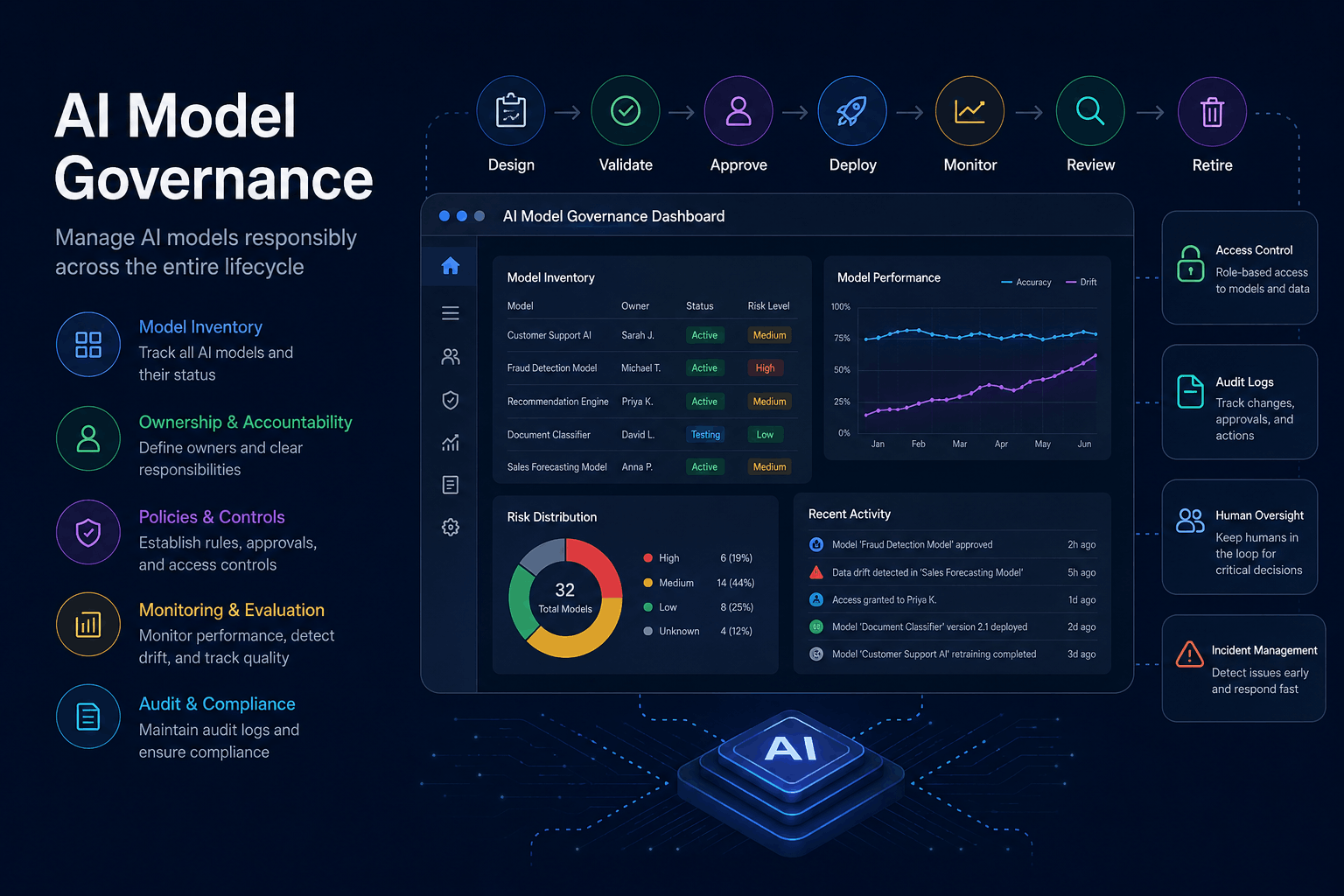
Model inventory
Organizations need a centralized inventory of AI systems.
Typical fields include:
- model owner
- intended use
- deployment status
- business unit
- training source
- risk category
- deployment date
Without inventory management, companies often discover shadow AI systems operating with little oversight.
Ownership and accountability
Every model needs a clearly assigned owner.
Ownership commonly includes:
- approvals
- monitoring
- lifecycle management
- documentation
- incident response
Validation and testing
Validation frequently includes:
- bias review
- performance testing
- security checks
- edge-case analysis
- business rule validation
Monitoring
Monitoring tracks:
- drift
- failures
- unusual behavior
- performance changes
- prediction quality
Audit logs
Governance requires historical visibility.
Teams often need records showing:
- who changed a model
- who approved deployment
- permission changes
- operational incidents
AI model governance lifecycle
Governance works best when integrated into the entire lifecycle:
Design → Validation → Approval → Deployment → Monitoring → Incident Review → Retirement
Organizations often invest heavily in deployment while underestimating monitoring and retirement.
AI model governance best practices
Strong governance tends to be practical.
Maintain a model inventory
Know what exists and who owns it.
Require approval workflows
High-impact systems should not move directly into production.
Define risk categories
Not every AI system carries the same risk.
Track changes
Historical visibility reduces confusion.
Include human oversight
Automation alone rarely works in high-risk environments.
Review systems regularly
Models change over time.
Common AI model governance policies and controls
Policies do not need to become complicated documents. Teams usually benefit more from simple rules people actually follow.
What teams actually need from AI model governance tools
Organizations usually need capabilities rather than one massive platform:
- model inventory management
- ownership tracking
- approval workflows
- audit history
- monitoring visibility
- permissions
- incident tracking
- review queues
- human oversight
Governance usually becomes a workflow challenge rather than a software challenge.
How to operationalize AI model governance with internal tools
Policies often live in documents while operations happen elsewhere. Ownership sits in spreadsheets. Reviews happen in tickets. Incidents live in separate systems.
Eventually governance becomes fragmented.
Organizations frequently build:
- review dashboards
- model inventories
- exception queues
- approval workflows
- audit interfaces
- monitoring systems
Many teams discover governance is less about one centralized platform and more about operational workflows.
Teams can build AI governance workflows around existing AI systems and create internal interfaces for operational processes.
Examples include:
- model review portals
- AI inventory dashboards
- exception workflows
- approval systems
- human-in-the-loop interfaces
Teams can also connect OpenAI to internal tools and build operational applications around AI systems.
Organizations needing visibility and operational controls often rely on:
- audit logs
- access control and audit logging
- role-based data access
The goal is not replacing dedicated governance platforms. The goal is operationalizing governance processes.
AI model governance checklist
- Maintain a model inventory
- Assign ownership
- Create approval workflows
- Define risk categories
- Document intended use
- Monitor production behavior
- Log operational events
- Establish incident procedures
- Review systems regularly
- Retire outdated models
Final thoughts
AI model governance is becoming less about policies and more about operations. Organizations rarely fail because they lack documentation. They fail because governance processes never become part of daily workflows.
The teams that succeed build systems around AI: visibility, ownership, approvals, review processes, and accountability. Governance becomes practical once it becomes operational.
Next step
Planning a HIPAA-sensitive internal app?
Use the checklist above to map data flow, roles, audit events, vendors, and deployment decisions before the first production workflow ships.
Healthcare operations example
Action Behavior Centers scaled internal operations across clinics with UI Bakery
For a real operational example, review UI Bakery customer stories and healthcare operations patterns.
5,000+users supported in the customer story
400+clinics mentioned in the case study
What is AI model governance?
AI model governance is the set of policies, controls, workflows, and monitoring practices used to manage AI models throughout their lifecycle.
What is the difference between AI governance and AI model governance?
AI governance covers organization-wide strategy and principles. AI model governance focuses on operational management of individual models.
What should an AI model governance framework include?
Inventory management, ownership, validation, monitoring, approvals, audit trails, and human oversight.
Who owns AI model governance?
Ownership is generally shared between engineering, operations, risk, compliance, and security teams.
What are AI model governance tools?
They help organizations track AI systems, manage workflows, monitor behavior, and maintain operational visibility.
How do audit logs support AI model governance?
Audit logs provide historical visibility into approvals, changes, operational events, and accountability.





"The UI Bakery platform offers a cost-effective approach to creating applications. With UI Bakery, you can achieve your app development goals without breaking the bank."

"Before switching to UI Bakery we developed a number of apps within the Retool system. The Retool system was good but ultimately did not have the flexibility and feature sets that we required."
Check the Story