

7 Best Supabase Alternatives in 2026: Compared by Use Case, Pricing, and Self-Hosting

Updated:
February 21, 2026
Supabase is one of the strongest backend-as-a-service platforms for teams that want PostgreSQL, built-in auth, storage, realtime, and fast developer onboarding. But it is not always the best fit.
Some teams need stronger mobile tooling, some want more control over self-hosting, some prefer GraphQL-first architecture, and others do not want their frontend tied too tightly to a single backend choice.
If you are comparing Supabase alternatives in 2026, the right option depends less on hype and more on your stack, team, hosting model, and product type. This guide compares the best alternatives by database model, pricing approach, self-hosting, and best-fit use case.
For a detailed breakdown of what Supabase itself costs, check out our Supabase pricing guide: free tier limits, plans and full breakdown.
Best Supabase alternatives at a glance
If you do not want to read the full comparison yet, start here:
- Choose Firebase if you are building mobile-first apps and want analytics, push notifications, and the Google ecosystem.
- Choose Appwrite if you want an open-source BaaS with strong self-hosting control.
- Choose Nhost if you want Postgres plus a more GraphQL-first workflow.
- Choose PocketBase if you want the lightest possible backend for side projects or prototypes.
- Choose Backendless if your team wants visual backend logic and no-code support.
- Choose UI Bakery if your main problem is building internal tools, admin panels, or operational apps on top of any backend you choose.
TL;DR: When supabase works and when It does not
When Supabase is the right choice and when it is not
Suggested structure:
Supabase is still a strong choice if you:
- want PostgreSQL at the center of the stack
- need auth, storage, and realtime in one product
- want an open-source product with self-hosting options
- are building an MVP or early production app
Consider an alternative if you:
- want stronger mobile SDK and analytics depth
- prefer GraphQL-first APIs
- need a simpler local or single-binary backend
- want a visual backend builder for non-developers
- need to build internal tools faster across multiple data sources
Firebase
Still the original BaaS benchmark, Firebase by Google remains a top pick for mobile-first development and rapid prototyping in 2026. Its ecosystem includes Firestore, Cloud Functions, authentication, analytics, crash reporting (Crashlytics), and performance monitoring — all tightly integrated with Google Cloud.
Best for: Mobile apps, fast prototyping, real-time sync apps.
Key features:
- Firestore (NoSQL) and Realtime Database with offline support
- Built-in auth with email, phone, and social providers (50K free MAUs)
- Firebase Studio for app prototyping with Gemini AI
- Push notifications (FCM), analytics, A/B testing, and Remote Config
- Deep integration with Google Cloud infrastructure
Pricing: Spark plan (free) with generous no-cost quotas. Blaze plan is pay-as-you-go — you only pay for what you use beyond free limits. Costs can escalate quickly at scale, especially with high read/write volumes on Firestore and SMS-based authentication.
Why consider it over Supabase:
- More mature mobile ecosystem with native SDKs and Firebase Studio
- Built-in analytics, crash reporting, and performance monitoring
- Push notifications (FCM) included at no extra cost
- Stronger integration with the broader Google Cloud platform
Limitations:
- Vendor lock-in with Google Cloud
- NoSQL only (Firestore) — no relational database option
- Closed source, no self-hosting
- Pricing can be hard to predict at scale, especially for read-heavy apps
Appwrite
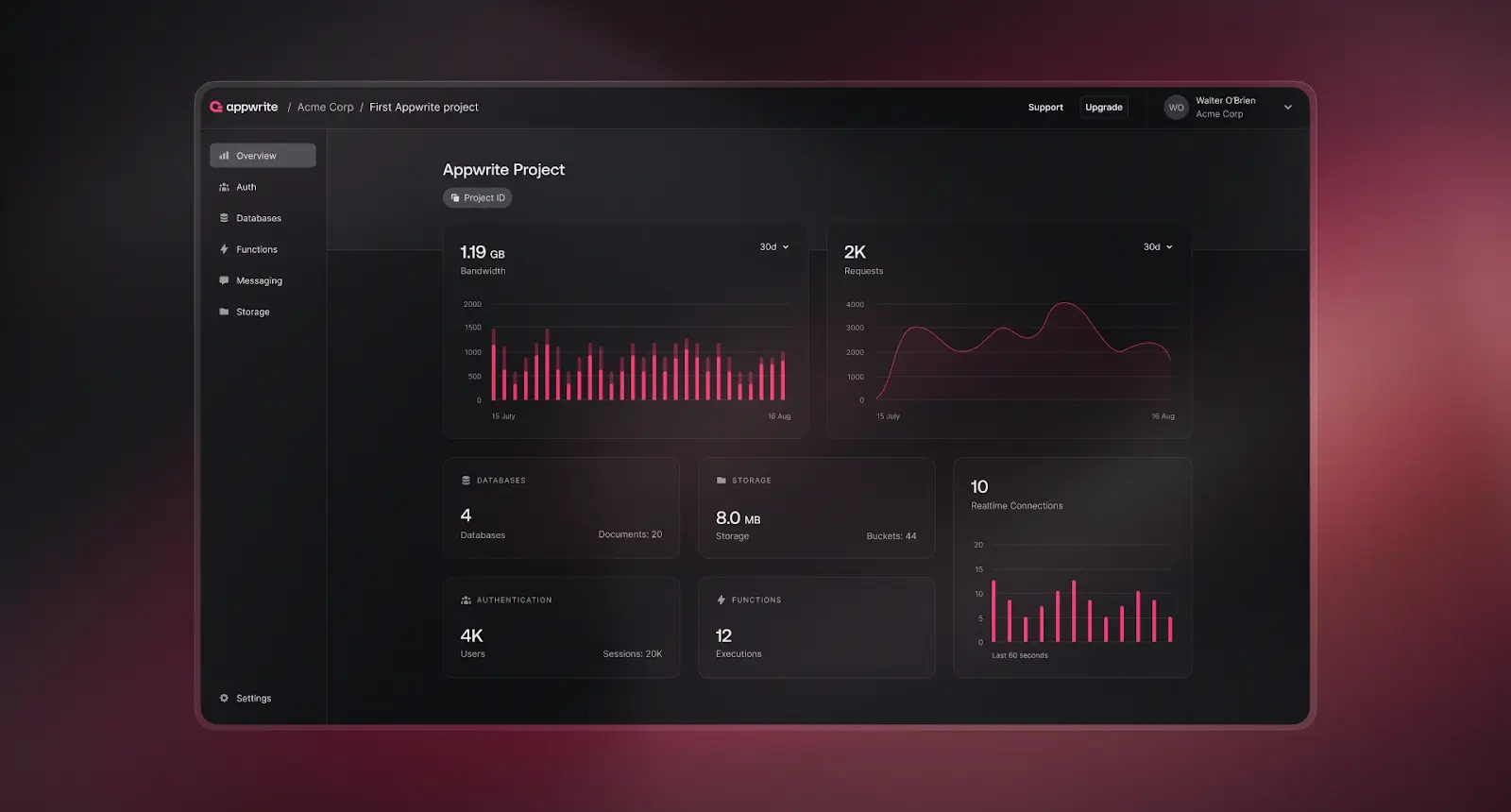
Appwrite is a developer-focused, open-source BaaS built for teams who want full backend control without vendor lock-in. Written in TypeScript and Go, Appwrite offers a complete self-hostable backend with auth, databases, storage, serverless functions, messaging, and even static site hosting as of 2025.
Best for: Teams who want full backend ownership with a modern developer experience.
Key features:
- Self-hosted backend with Auth, Databases, Storage, Functions, and Messaging
- Cloud offering with multi-region support (Frankfurt, NYC, Sydney)
- SDKs for web, Flutter, Android, iOS, and more
- Modern admin UI for project management
- Native Docker-based setup for self-hosting
Pricing: Free tier includes 2 projects (paused after 7 days of inactivity). Pro plan is $25/month per project (updated September 2025) with 2TB bandwidth, 1.75M database reads, and 750K writes included. Scale and Enterprise plans available for larger teams. Self-hosted is free and unlimited.
Why consider it over Supabase:
- Fully self-hostable with no limits on the open-source version
- Includes messaging (email, SMS, push) and static site hosting out of the box
- Modern admin dashboard with a clean UI
- Per-project pricing model (vs. Supabase per-organization model)
Limitations:
- Uses MariaDB, not PostgreSQL (less familiar for some teams)
- Cloud free tier is more restrictive than Supabase (projects pause after inactivity)
- Smaller community compared to Supabase and Firebase
Nhost
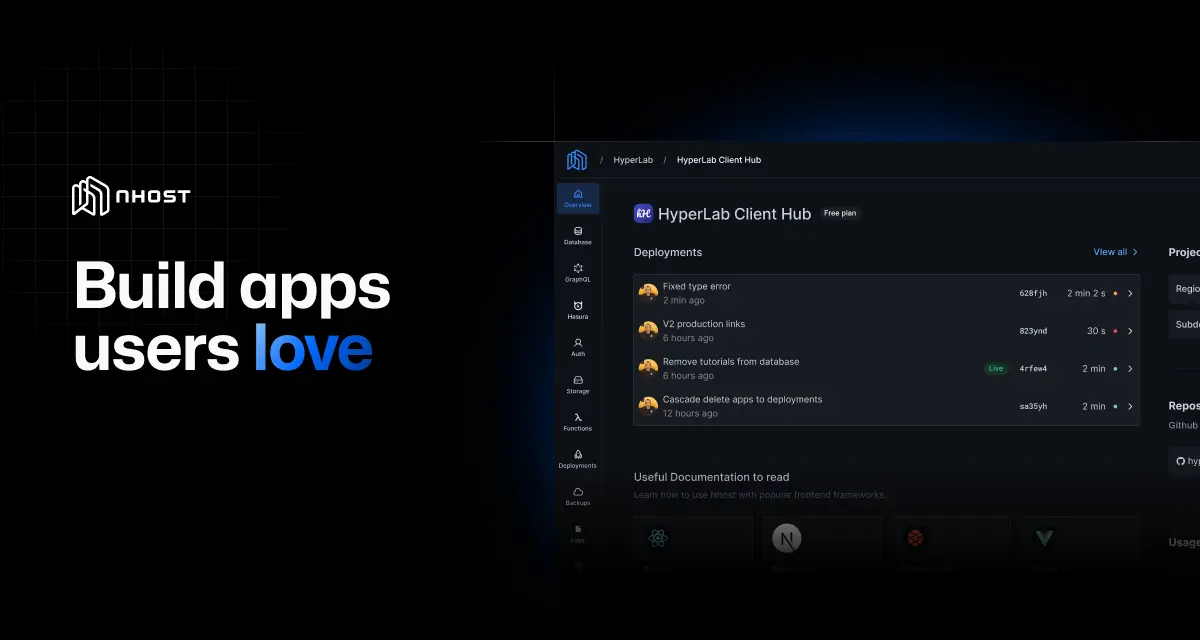
Nhost takes a similar approach to Supabase by building on PostgreSQL, but pairs it with Hasura to deliver instant GraphQL APIs. If your stack is GraphQL-first or you are building JAMstack apps, Nhost is one of the most compelling Supabase alternatives in 2026.
Best for: Teams building GraphQL-first APIs or JAMstack applications.
Key features:
- Hasura under the hood for instant GraphQL APIs on PostgreSQL
- Built-in Auth, Storage, and Serverless Functions
- CLI-first developer experience with Git-based deployments
- Built-in migration and CI/CD tooling
- Open source with both cloud-hosted and self-hosted options
Pricing: Free Starter plan includes 1GB database, 1GB storage, and 5GB bandwidth (projects pause after 7 days of inactivity). Pro plan starts at $25/month with $15 in compute credits included. Dedicated compute available from $50 per vCPU/2GB RAM.
Why consider it over Supabase:
- GraphQL-native with Hasura — better DX for GraphQL-heavy teams
- Built-in CI/CD and database migration workflows
- Strong CLI and SDK support for modern development workflows
Limitations:
- Smaller team and community compared to Supabase (7 employees as of 2025)
- Less flexibility if you do not want GraphQL
- Fewer integrations and third-party tooling
UI Bakery
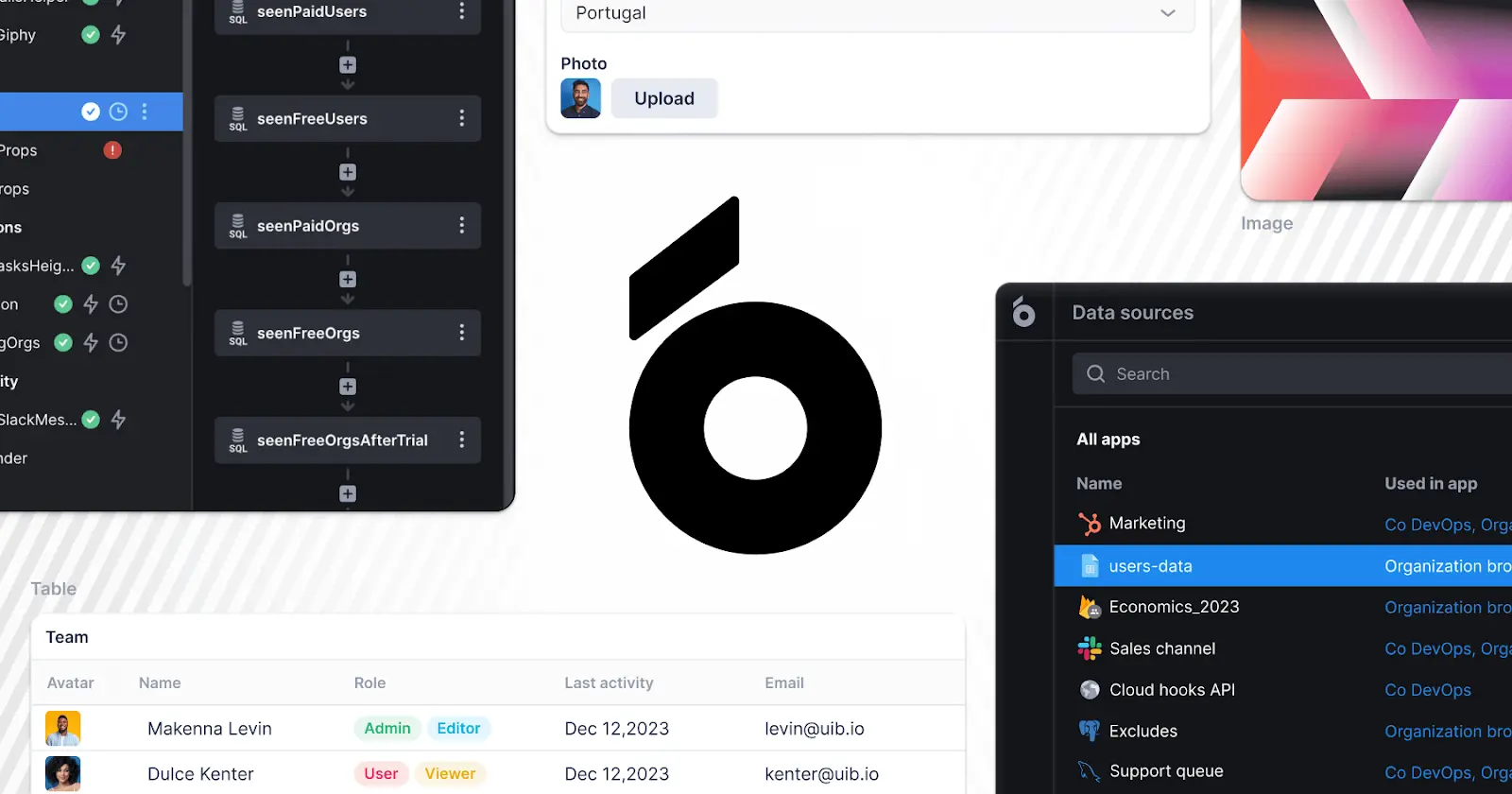
UI Bakery is not a direct backend replacement, but a low-code platform with an AI Agent for building internal tools, admin panels, and dashboards on top of any backend — including Supabase, Firebase, or any of the alternatives listed here.
Best for: teams building internal tools, admin panels, dashboards, and workflow apps across any backend or database.
Key features:
- Connects to PostgreSQL, MySQL, MongoDB, Firebase, REST APIs, GraphQL, and more
- AI-powered app generation from your data schema
- Drag-and-drop UI builder with custom components
- SOC 2, GDPR compliant with on-premise deployment options
- Role-based access control and SSO
Pricing: Free plan available. Paid plans with custom pricing for teams and enterprise deployments.
Why it complements or replaces parts of Supabase:
- If you are switching backends, UI Bakery maintains your UI layer without rebuilding from scratch
- Works with any backend or database — you are never locked into one BaaS provider
- Ideal for rapidly building internal tools that would take weeks to code manually
- Combines well with any backend from this list for a complete full-stack setup
If your team likes Supabase for backend speed but still needs to build operational interfaces quickly, UI Bakery can sit on top of Supabase or any alternative in this list.
PocketBase
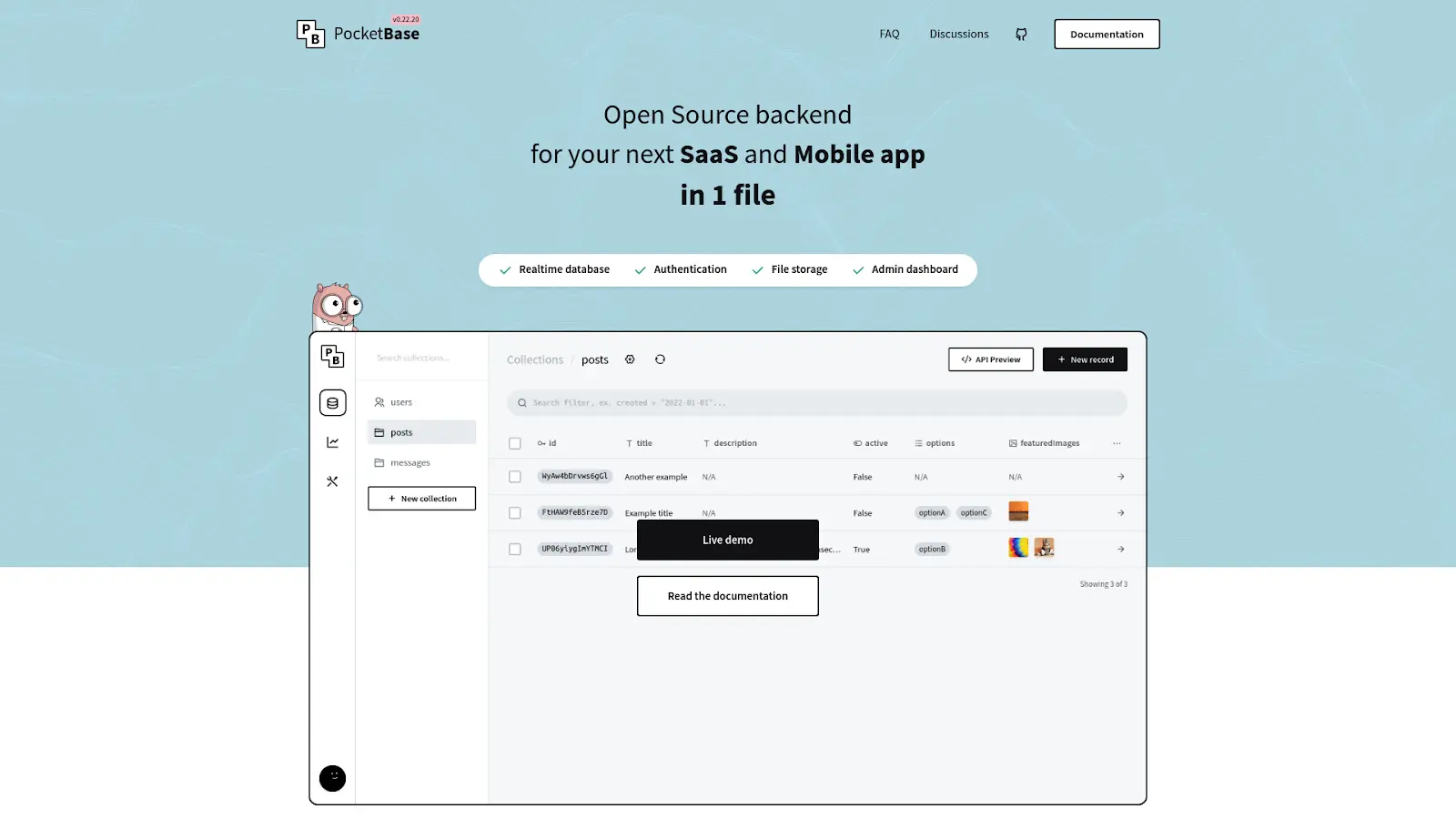
PocketBase is a lightweight, Go-based backend that ships as a single binary with a built-in SQLite database, authentication, file storage, and an admin dashboard. It is ideal for solo developers, side projects, or micro-SaaS apps where simplicity is more important than scale.
Best for: Indie developers, side projects, local-first apps, and embedded backends.
Key features:
- Single binary — download, run, done. No dependencies, no Docker required
- Built-in SQLite database with real-time subscriptions (SSE)
- Auth, file storage, and admin dashboard included
- Can run in-browser via WebAssembly (WASM)
- Extendable with Go hooks for custom logic
Pricing: Completely free and open source. You only pay for the server you host it on. Managed hosting options available through third-party providers (PocketHost, Elestio, Hostinger VPS, etc.).
Why consider it over Supabase:
- Zero infrastructure complexity — one binary, one file, done
- No cloud dependency — runs anywhere, including locally
- Perfect for prototypes and small apps where Supabase is overkill
- Extremely portable — easy to move between environments
Limitations:
- SQLite is not suited for high-concurrency or multi-server setups
- No built-in serverless functions
- Limited scalability — most teams outgrow PocketBase as traffic increases
- Smaller ecosystem and fewer integrations
Backendless
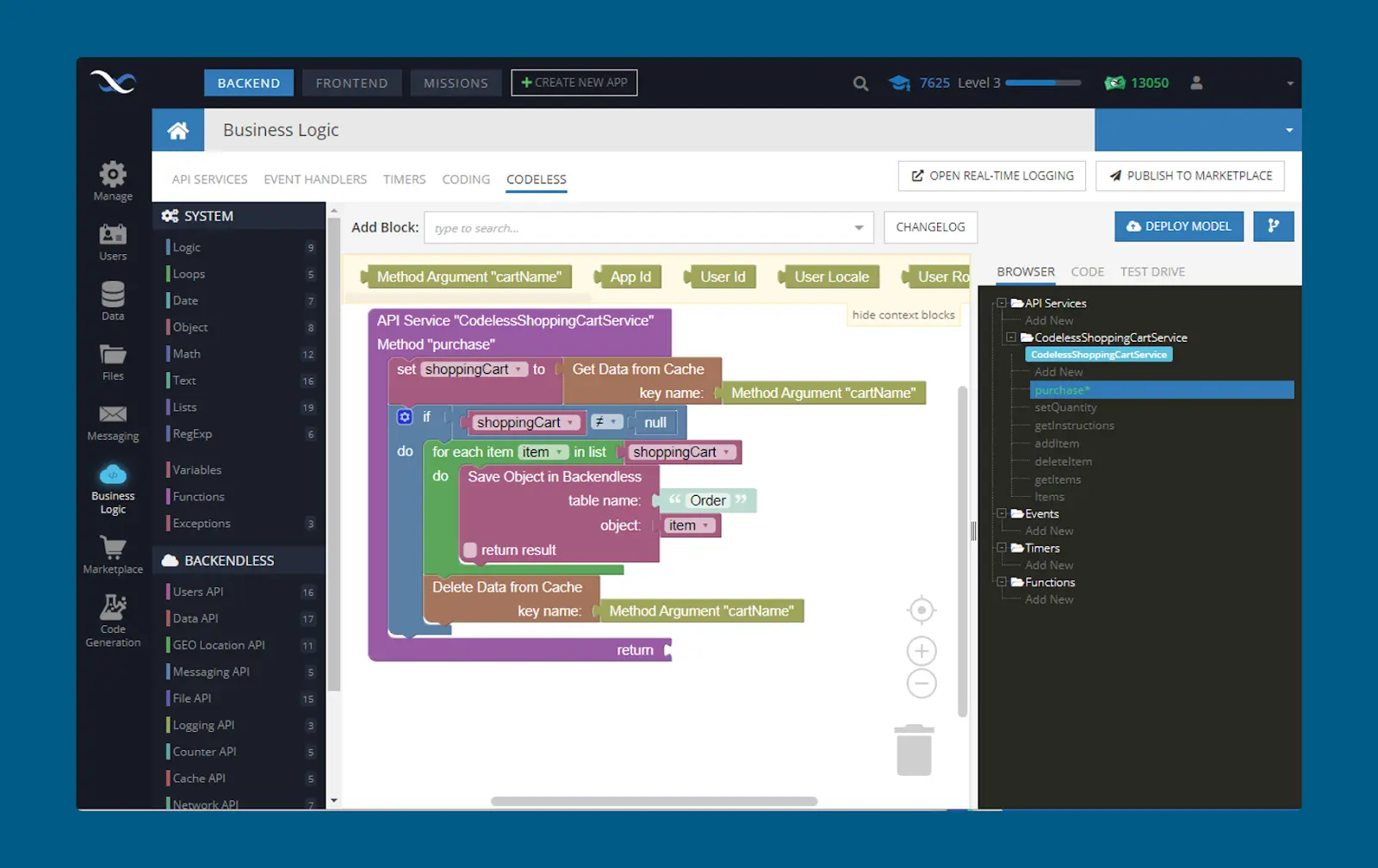
Backendless is a feature-rich BaaS with a strong visual development layer, making it a good choice for teams that want both no-code and code-based backend workflows. It supports a visual schema designer, Codeless (its proprietary visual logic builder), push notifications, and multi-database support.
Best for: Teams that want visual backend builders with drag-and-drop logic, especially for non-developer team members.
Key features:
- Visual schema designer and Codeless (drag-and-drop backend logic)
- Built-in push notifications, real-time database, and geolocation
- Multi-database support with API management
- Cloud and on-premises deployment options
- Marketplace with add-ons and plugins
Pricing: Free Springboard plan with limited resources (20 tables, 15K objects, 1GB storage). Cloud plans from $15/month (Scale) to $149/month. On-premises (Pro and Managed) plans with unlimited resources are available at higher price points.
Why consider it over Supabase:
- Visual backend builder (Codeless) lowers the bar for non-developers
- Built-in push notifications without third-party integrations
- On-premises option with unlimited resources on Managed plans
Limitations:
- Closed source (cloud version)
- More opinionated architecture with a steeper learning curve for advanced features
- Codeless is proprietary and does not transfer to other platforms
Best Supabase alternative by use case
Best for mobile-first apps: Firebase. Unmatched ecosystem for iOS and Android with SDKs, push notifications, analytics, crash reporting, and offline sync built in.
Best for GraphQL APIs: Nhost. Built on Hasura + PostgreSQL, it gives you instant GraphQL APIs, subscriptions, and a strong CLI-based developer experience.
Best for full self-hosted control: Appwrite. Open-source with Docker-based deployment, no usage limits on self-hosted, and a modern admin UI.
Best for solo devs and side projects: PocketBase. A single binary with zero dependencies — download, run, and you have a backend with auth, database, and file storage.
Best for non-technical teams and no-code: Backendless. Visual schema designer and Codeless logic builder let non-developers build and manage backend logic.
Best for internal tools and dashboards: UI Bakery. Connects to any database or API and lets you build admin panels, dashboards, and internal tools with drag-and-drop — no matter which backend you choose.
Best for enterprise and compliance: Firebase (with Google Cloud) or Appwrite (self-hosted) for organizations that need SOC 2, HIPAA, or on-prem deployment. UI Bakery also offers SOC 2, GDPR, and on-premise options for the UI layer.
Cheapest alternative: PocketBase (free, self-hosted) for minimal cost. For managed BaaS, Backendless ($15/month) or Supabase/Appwrite/Nhost (all $25/month on Pro tiers) depending on your specific usage patterns.
Conclusion
The Supabase alternatives landscape in 2026 is broader than ever. Whether you need a GraphQL-native backend (Nhost), a lightweight single-binary solution (PocketBase), a mobile-first platform with deep analytics (Firebase), a fully self-hosted open-source stack (Appwrite), or a visual no-code backend builder (Backendless), there is a strong option for nearly every use case.
The right choice depends on your architecture needs, team composition, hosting preferences, and budget. If you are unsure, start by identifying whether you need a direct BaaS replacement or a UI layer on top of your existing data.
If you are building internal tools or admin panels, UI Bakery works with any backend on this list — giving you the flexibility to switch BaaS providers without rebuilding your frontend. And if you are still weighing whether Supabase pricing works for your project, our detailed pricing breakdown can help you run the numbers before you commit.
FAQ
What is the best open-source alternative to Supabase?
Appwrite and Nhost are the strongest open-source alternatives. Appwrite offers a full self-hosted BaaS with Docker, while Nhost pairs PostgreSQL with Hasura for instant GraphQL APIs. PocketBase is another excellent open-source option for smaller projects that need a lightweight, single-binary backend.
Is Firebase still a good alternative to Supabase in 2026?
Yes, especially for mobile-first apps. Firebase offers a more mature mobile ecosystem with native SDKs, push notifications (FCM), crash reporting, and analytics. However, it uses NoSQL (Firestore) instead of a relational database, and there is no self-hosting option, which creates vendor lock-in with Google Cloud.
What is the cheapest Supabase alternative?
PocketBase is completely free and open source — you only pay for hosting. For managed BaaS platforms, Backendless starts at $15/month, while Appwrite, Nhost, and Supabase all offer Pro plans at $25/month. Firebase uses a pay-as-you-go model that can be cheaper or more expensive depending on your usage patterns.
Can I use Supabase alternatives with UI Bakery?
Yes. UI Bakery connects to any REST or GraphQL API, as well as databases like PostgreSQL, MySQL, MongoDB, and Firebase directly. This means you can use UI Bakery as your frontend/internal tool layer on top of any backend from this list.
Which Supabase alternative is best for building internal tools?
UI Bakery is purpose-built for internal tools, dashboards, and admin panels. It connects to any backend or database and lets you build UIs with drag-and-drop components, role-based access control, and AI-powered app generation. Combine it with any backend from this list for a complete stack.
Is Supabase free to use?
Supabase offers a free tier with 500MB database storage, 50K monthly active users, and 1GB file storage. However, free projects pause after 7 days of inactivity, and you are limited to 2 projects. For production use, most teams need the Pro plan at $25/month, with real-world costs typically landing between $35 and $125/month depending on usage. See our full Supabase pricing breakdown for details.
Next step
Planning a HIPAA-sensitive internal app?
Use the checklist above to map data flow, roles, audit events, vendors, and deployment decisions before the first production workflow ships.
Healthcare operations example
Action Behavior Centers scaled internal operations across clinics with UI Bakery
For a real operational example, review UI Bakery customer stories and healthcare operations patterns.
5,000+users supported in the customer story
400+clinics mentioned in the case study




"The UI Bakery platform offers a cost-effective approach to creating applications. With UI Bakery, you can achieve your app development goals without breaking the bank."

"Before switching to UI Bakery we developed a number of apps within the Retool system. The Retool system was good but ultimately did not have the flexibility and feature sets that we required."
Check the Story