

Best n8n Alternatives: Top Workflow Automation Tools in 2026

Updated:
April 5, 2026
The best n8n alternatives in 2026 are Zapier (simplest no-code option), UI Bakery (best for internal tools and operational interfaces), Make (best visual workflow builder), Pipedream (best for developers), and Workato (best for enterprise automation). If you need a free, open source alternative to n8n, Activepieces and Windmill are worth considering. The right choice depends on your team's technical level, deployment needs, and workflow complexity.
Introduction
While n8n is a powerful workflow automation tool, many teams start looking for alternatives once they move beyond initial experimentation. The need for easier onboarding, better UI, stronger AI capabilities, or more production-ready workflows often pushes teams to explore other options.
Today's automation landscape is broader than ever. From no-code automation tools to AI workflow builders, open source automation platforms, and developer-first tools, there are multiple ways to build and scale automation without being tied to a single tool.
In this guide, we'll explore the best n8n alternatives for 2026, compare their features and pricing, and help you understand which tool fits your workflow, team structure, and technical requirements — whether you're looking for free alternatives to n8n, open source alternatives to n8n, or enterprise-grade automation platforms.
Comparison table: n8n alternatives at a glance
Quick picks
- Best free alternative to n8n → Activepieces (open source, self-hostable, zero vendor lock-in)
- Best open source alternative to n8n → Windmill (code-first, self-hosted, scripts + flows)
- Best no-code alternative to n8n → Zapier (fastest setup, 6,000+ integrations)
- Best visual workflow automation alternative → Make (powerful logic without writing code)
- Best for internal tools and operational interfaces → UI Bakery (bridges automation and real UI)
- Best for developers → Pipedream (Node.js, Python, event-driven, API-first)
- Best for enterprise → Workato (governance, compliance, AI workflows at scale)
- Best n8n alternative for AI agents → Pipedream or Workato (both support AI-driven decision-making in production)
How we evaluated these tools
To give a fair and practical comparison of n8n alternatives, we evaluated each tool based on:
- Ease of use — Can non-developers build and manage workflows independently?
- Flexibility — Support for custom logic, APIs, and scripting when needed.
- AI capabilities — Support for AI workflows, AI agents, and intelligent automation logic.
- Deployment options — Cloud vs self-hosted; important for teams with data privacy or compliance needs.
- Open source availability — Whether a free, self-hostable version exists.
- Scalability — Suitable for production workflows, not just prototypes.
- Pricing transparency — Clear, predictable pricing without hidden per-step charges.
1. Zapier
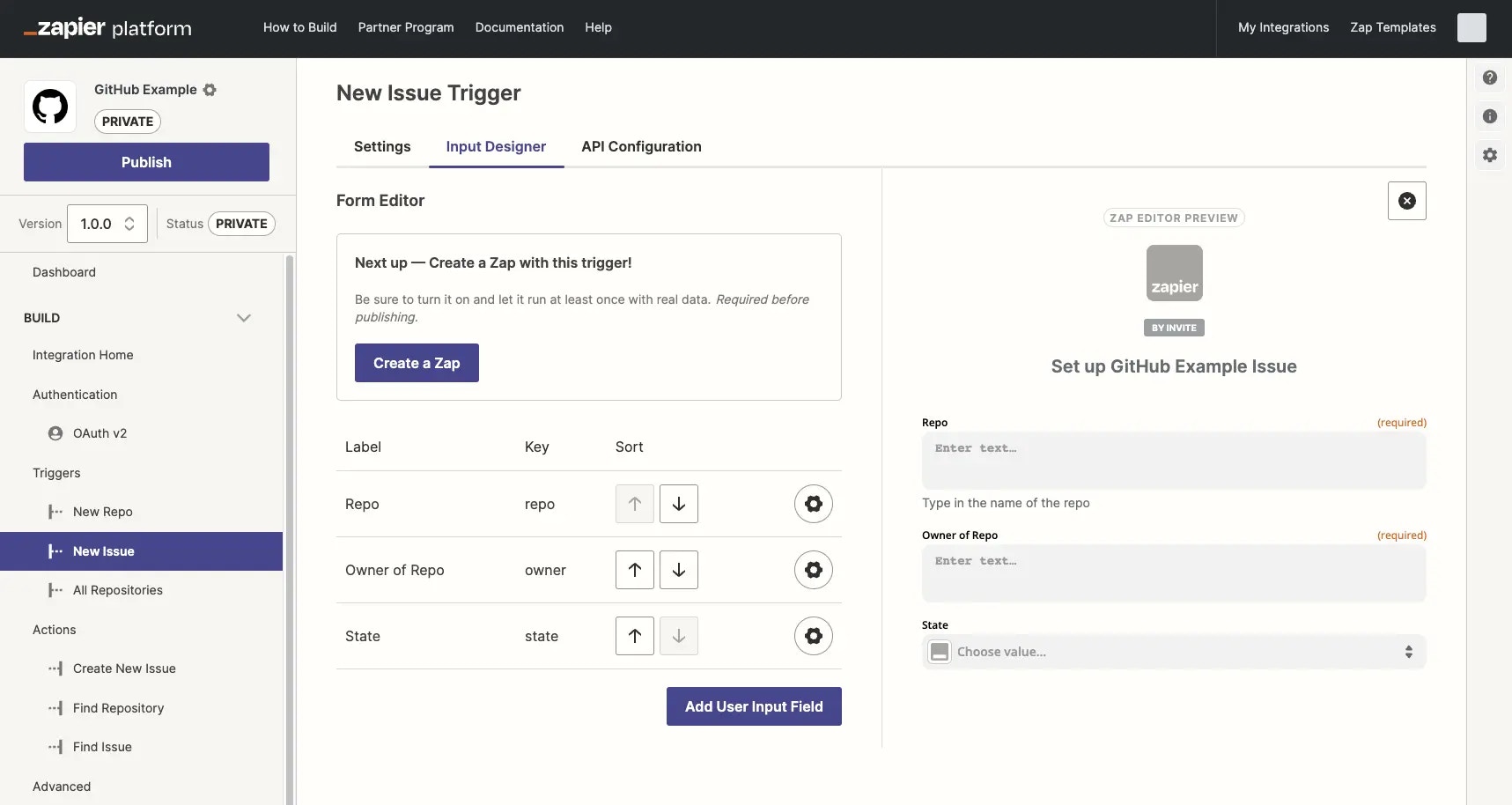
Zapier is the most widely adopted workflow automation tool on the market, known for its simplicity and breadth of integrations. It allows users to connect apps and automate workflows without any coding. While it now includes some AI integrations, it lacks the depth of n8n AI agent features or n8n agentic AI capabilities. It works best for simple, linear automations like notifications, data syncing, or CRM updates.
Key strengths:
- Extensive integration ecosystem (6,000+ apps).
- Extremely low barrier to entry.
- Fast time-to-value for simple automations.
- Built-in templates and automation patterns.
- Reliable execution for linear, trigger-action workflows.
Pros: Beginner-friendly, no infrastructure to manage, strong reliability, wide community support, quick onboarding.
Cons: Costs scale aggressively with usage (per-step billing), limited flexibility for complex logic, not suitable for self-hosting or sensitive data environments, restricted customization compared to developer-first tools.
Best for: Non-technical teams running straightforward automations between popular SaaS tools.
2. UI Bakery
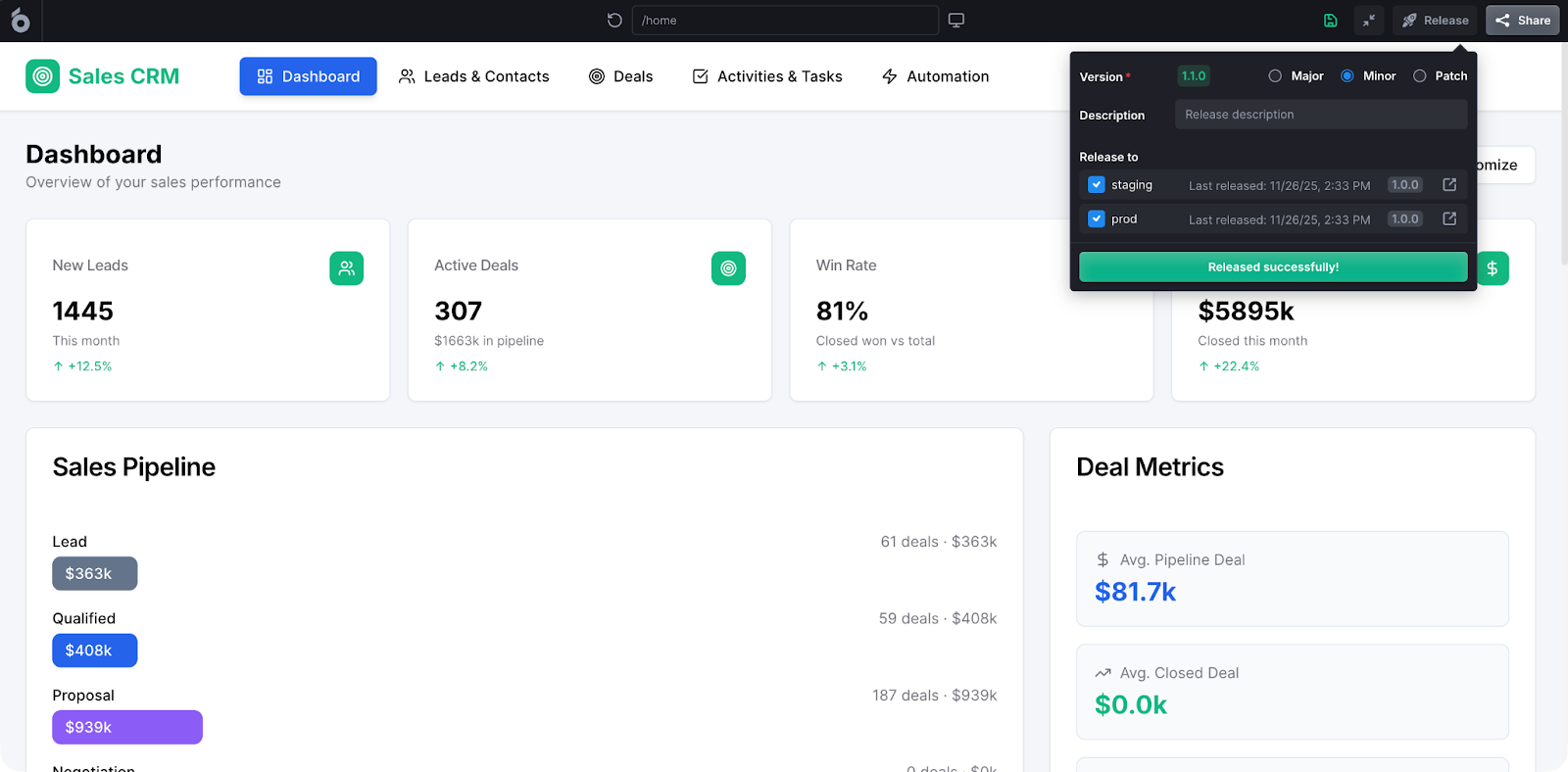
UI Bakery fits into the n8n alternatives landscape differently from the other tools in this list. While most workflow automation alternatives to n8n focus on replacing its backend orchestration, UI Bakery solves a different problem: giving teams a real interface to interact with automation.
In practice, teams often use n8n (or one of its alternatives) for automation logic while using UI Bakery to build dashboards, admin panels, and operational tools on top of that logic. This makes it easier for non-technical users to trigger automations, review data, and manage workflows without touching the underlying system.
UI Bakery connects directly to APIs, SQL and NoSQL databases, and services, and supports role-based access controls and enterprise workflows. Rather than replacing n8n automation, it complements it — turning automated processes into usable internal systems.
Key strengths:
- Designed specifically for building internal tools on top of workflows and data.
- Works alongside automation tools like n8n, Make, or Zapier.
- Direct database and API connectivity.
- Role-based access for ops, support, and business teams.
- Bridges the gap between backend automation and everyday usage.
Pros: Turns automation into an operational product, reduces reliance on engineers for routine tasks, strong integration ecosystem, suitable for teams of all sizes.
Cons: Not a standalone automation engine — requires existing workflows or data sources to unlock full value. Less focused on backend logic compared to n8n or Pipedream.
Best for: Teams that need to build internal dashboards and tools on top of existing automation and data pipelines.
3. Make
Make (formerly Integromat) provides a visual approach to workflow automation with powerful multi-step logic, making it one of the most practical open source alternatives to n8n for teams that prefer a UI-driven experience. It's more flexible than Zapier but still more accessible than n8n. It supports AI integrations but doesn't fully embrace n8n AI agents or advanced n8n agentic AI patterns.
Make's pricing model is also more affordable at entry level than n8n Cloud, making it a popular free alternative to n8n for small teams testing automation workflows.

Key strengths:
- Advanced visual workflow builder.
- Better handling of multi-step logic compared to Zapier.
- Balanced pricing model with a usable free tier.
- Large integration library (~3,000 apps).
- Strong data manipulation and transformation tools.
Pros: Great balance of power and usability, visual debugging, affordable for growing teams, strong for multi-step workflows in marketing ops, finance, and SaaS integrations.
Cons: Cloud-only (no self-hosting option), AI capabilities not deeply integrated, limited flexibility compared to developer-first n8n alternatives like Pipedream.
Best for: Teams that want visual workflow automation with more logic than Zapier but less technical complexity than n8n.
4. Pipedream
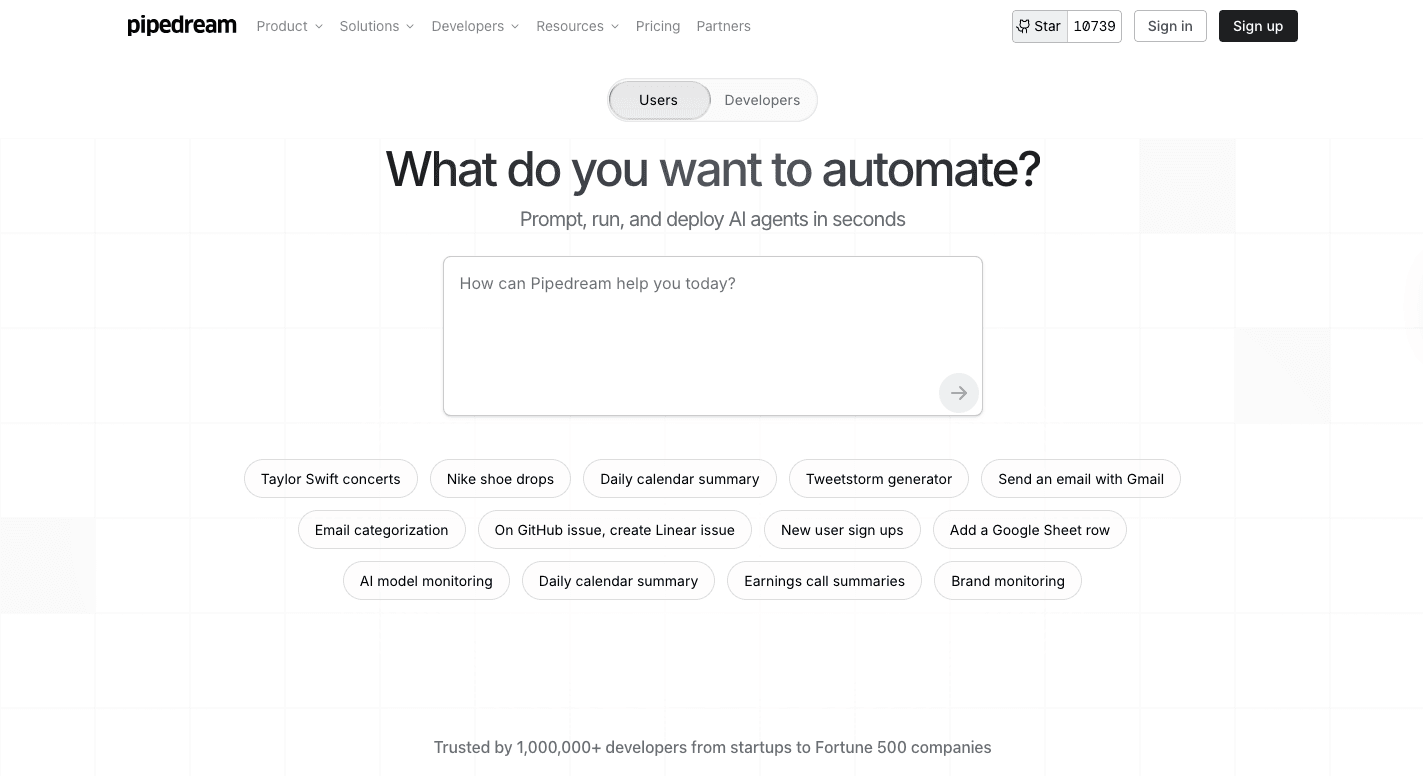
Pipedream is a developer-first automation platform built for engineers who need full control over workflows using code. It's one of the strongest n8n alternatives for AI agents, since it allows teams to build AI-driven logic directly in Node.js or Python without the constraints of no-code tools. Its event-driven architecture makes it ideal for real-time workflows and API-heavy automation.
Key strengths:
- Native code execution in workflows (Node.js, Python, and more).
- Event-driven architecture for real-time automation.
- Strong API-first design for custom system integration.
- Supports AI workflows and agent logic via code.
- Generous free tier with usage-based pricing.
Pros: Maximum customization and flexibility, fast execution, real-time triggers, strong fit for production-grade systems, capable of building AI automation logic without no-code constraints.
Cons: Not beginner-friendly, limited visual interface, smaller ecosystem compared to Zapier or Make, less structured workflow builder than n8n.
Best for: Developers and engineering teams building API-driven, real-time, or AI-powered automation workflows.
5. Workato
Workato is a leading enterprise-grade automation platform that enables teams to build workflows using a low-code interface connecting SaaS apps, APIs, databases, and business logic. What sets it apart from other n8n alternatives is its focus on enterprise orchestration — bringing automation, integration, and data workflows together in a single scalable system with built-in governance.
With Workato AI, the platform supports intelligent automation for decision-making, data enrichment, and process automation. It covers use cases like automated support routing, financial operations, and predictive workflows at scale.

Key strengths:
- Enterprise-grade automation and integration platform.
- Strong AI automation and intelligent workflow capabilities.
- Large library of pre-built connectors and recipe-based automation.
- Built-in governance, security, and compliance features.
- Scalable architecture for complex, cross-department processes.
Pros: Powerful for large-scale automation, combines integration and automation in one platform, reliable for mission-critical workflows, strong enterprise support.
Cons: High cost compared to most n8n alternatives, complex initial setup, overkill for small teams or simple use cases, less flexibility for deep custom code than developer-first tools.
Best for: Large organizations needing enterprise automation, integration governance, and AI-powered workflows across multiple departments.
6. Activepieces
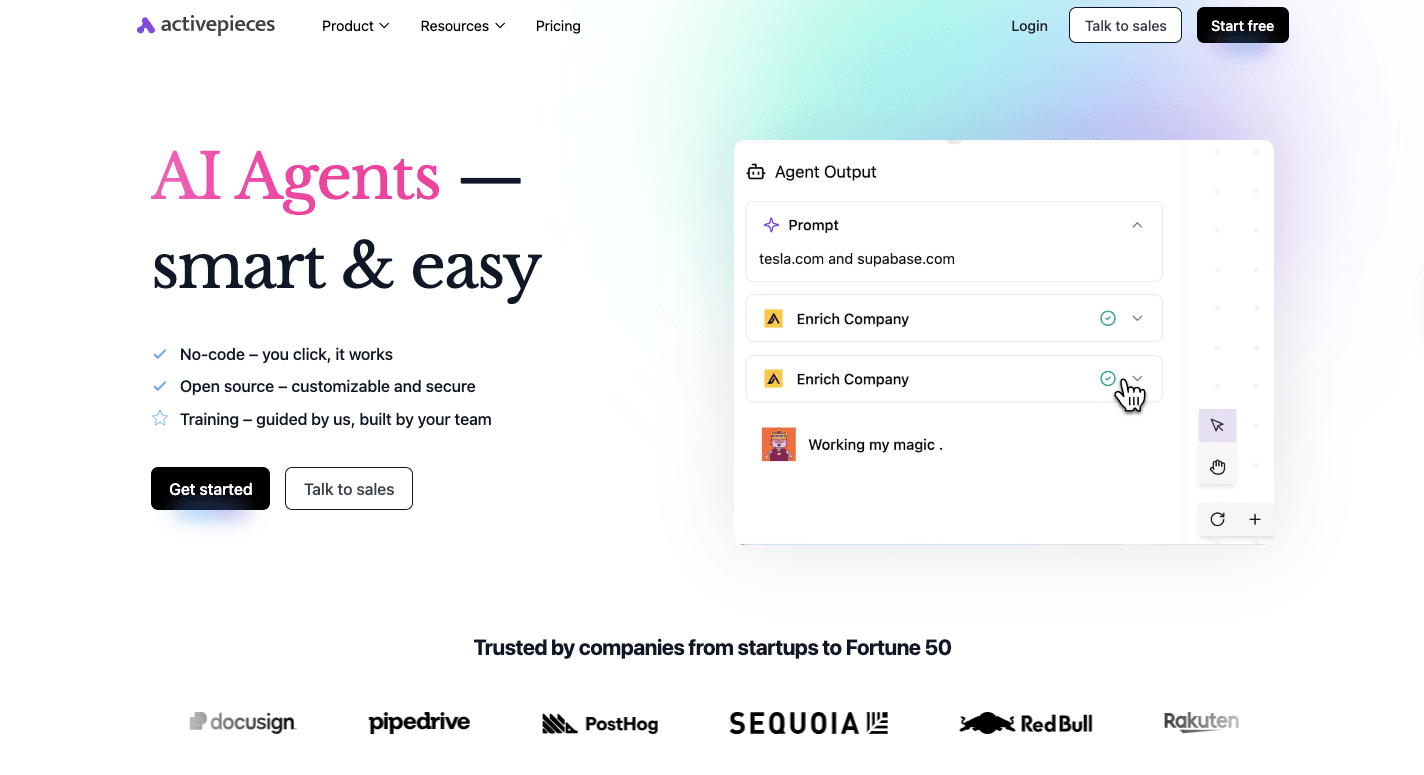
Activepieces is a free, open source alternative to n8n that follows a similar philosophy — self-hostable, extensible, and built for teams that want control over their automation infrastructure. It's simpler and faster to set up than n8n, making it a strong option for teams that want the benefits of open source workflow automation without the learning curve.
Key strengths:
- Fully open source and self-hostable with no vendor lock-in.
- Simpler setup than n8n, accessible to less technical teams.
- Active community and growing integration library.
- Usage-based pricing on the cloud tier.
Pros: Free to self-host, no execution limits on self-hosted version, easier onboarding than n8n, clean visual interface.
Cons: Smaller integration ecosystem, fewer advanced features, AI capabilities still maturing compared to more established platforms.
Best for: Teams looking for a free open source alternative to n8n with simpler onboarding and self-hosting flexibility.
7. Windmill
Windmill is an open source automation platform built primarily for developers. It focuses on scripts, flows, and apps — making it one of the best open source n8n alternatives for engineering teams that prefer writing logic directly rather than configuring nodes in a visual editor. It supports self-hosting and is particularly strong for internal tooling combined with automation.

Key strengths:
- Fully open source and self-hosted.
- Code-first workflow automation (Python, TypeScript, Bash, Go).
- Combines scripts, flows, and lightweight internal app building.
- Strong for developer teams building custom automation logic.
Pros: Maximum code control, no execution limits on self-hosted version, active open source development, integrates well with existing developer toolchains.
Cons: Steeper learning curve than visual tools, not suited for non-technical users, smaller community than n8n.
Best for: Engineering teams that want a self-hosted, open source n8n alternative with code-first workflow automation.
Final thoughts
n8n is a strong starting point for workflow automation, but it's not always the right long-term solution for every team. As workflows grow more complex, teams often need easier ways to build and manage automation, better collaboration across technical and non-technical users, or stronger integration with operational processes.
The market has evolved to cover every position in that spectrum:
- Automation engines for developers → Pipedream, Windmill
- No-code workflow automation alternatives → Zapier, Make
- Free open source alternatives to n8n → Activepieces, Windmill
- Enterprise automation platforms → Workato
- Operational and internal tooling → UI Bakery
The right choice depends on how your team works, not just what features a tool offers. If you're running simple SaaS automations, Zapier gets you there fastest. If you need open source workflow automation you can self-host, Activepieces or Windmill are strong free alternatives to n8n. If you're building complex, AI-powered automation at scale, Pipedream or Workato are worth evaluating. And if you need a real interface for your team to interact with any of these systems, UI Bakery fills that gap.
Next step
Planning a HIPAA-sensitive internal app?
Use the checklist above to map data flow, roles, audit events, vendors, and deployment decisions before the first production workflow ships.
Healthcare operations example
Action Behavior Centers scaled internal operations across clinics with UI Bakery
For a real operational example, review UI Bakery customer stories and healthcare operations patterns.
5,000+users supported in the customer story
400+clinics mentioned in the case study
What are the best n8n alternatives in 2026?
The best n8n alternatives include Zapier, Make, Pipedream, Workato, Activepieces, Windmill, and UI Bakery — each suited to different team sizes, technical levels, and use cases.
What are the best free alternatives to n8n?
Activepieces and Windmill are the strongest free, open source alternatives to n8n. Both are self-hostable with no execution limits on community editions.
What are the best open source alternatives to n8n?
Activepieces and Windmill are the top open source n8n alternatives. Both support self-hosting and give teams full control over their automation infrastructure.
Why do people look for alternatives to n8n?
Common reasons include setup complexity, self-hosting overhead, the need for simpler interfaces, better collaboration features, or stronger AI agent capabilities.
Which n8n alternative is easiest to use?
Zapier is the easiest to use for non-technical users. Make is a good middle ground — more powerful than Zapier but more visual than n8n.
Which tool is best for complex workflows?
n8n, Pipedream, and Workato are best suited for complex, API-driven, or enterprise-scale workflows.
Are there no-code alternatives to n8n?
Yes. Zapier and Make are the most popular no-code n8n workflow automation alternatives.
What is the best n8n alternative for AI agents?
Pipedream and Workato both support AI-powered automation in production. For teams already using n8n AI agents, Pipedream offers the most flexibility for building equivalent logic in code.
How do I choose the right automation tool?
Start with your team's technical level, deployment requirements (cloud vs self-hosted), and workflow complexity. Then compare pricing models — execution-based tools like n8n are cheaper at scale, while step-based tools like Zapier cost more as workflows grow.




"The UI Bakery platform offers a cost-effective approach to creating applications. With UI Bakery, you can achieve your app development goals without breaking the bank."

"Before switching to UI Bakery we developed a number of apps within the Retool system. The Retool system was good but ultimately did not have the flexibility and feature sets that we required."
Check the Story